Why does almost every list of sleep tips start with "go to bed and get up at the same time every day"? Because regularity and enough hours are the two things US sleep and health organizations agree on most. This note explains what they actually recommend, what the research on regular versus irregular schedules shows (and what it cannot show), and a gentle, week-by-week way to move a schedule that has drifted.
What the guidance says
How much. In 2015 the American Academy of Sleep Medicine and the Sleep Research Society published a joint consensus statement after reviewing the evidence. Its central recommendation: adults should sleep 7 or more hours per night on a regular basis [1]. The statement adds that more than 9 hours may be appropriate for some people, such as young adults or those catching up after short nights or recovering from illness [1]. The National Heart, Lung, and Blood Institute puts it as 7 to 9 hours a night for adults [2], and the CDC's sleep page says 7 or more hours for adults aged 18 to 60 [3].
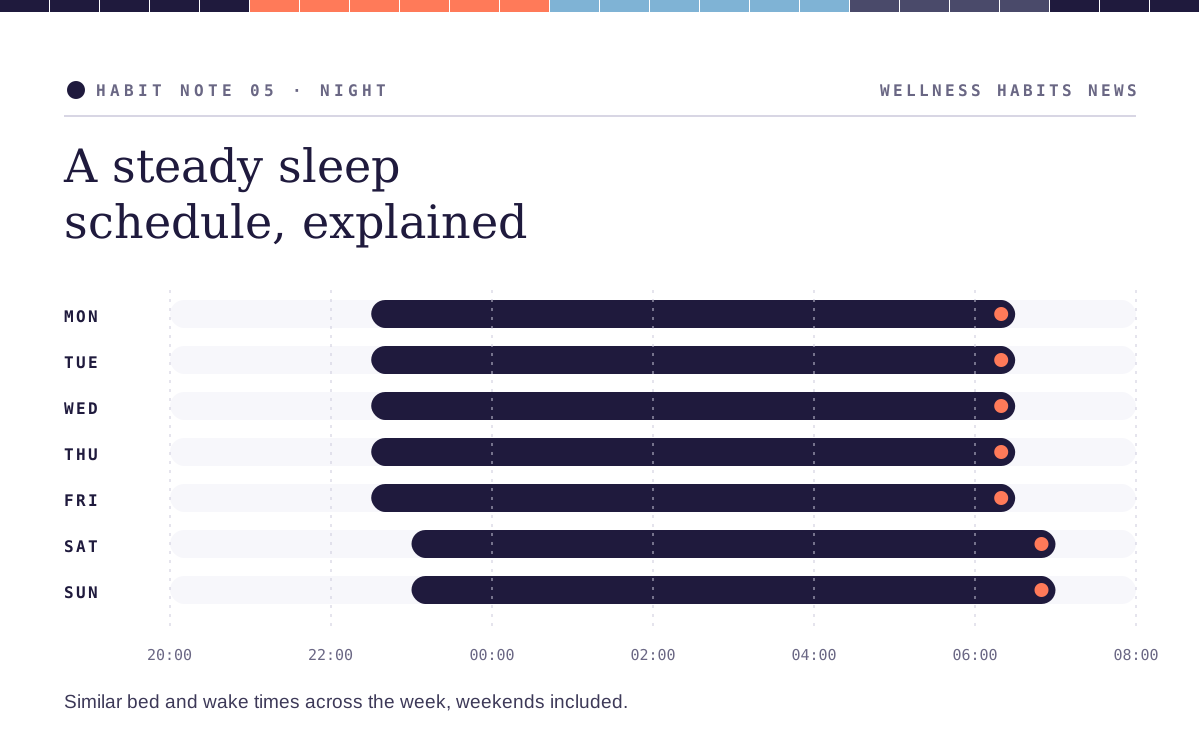
How regular. The AASM's healthy sleep habits list begins with keeping a consistent sleep schedule: get up at the same time every day, even on weekends or during vacations, and set a bedtime early enough to allow at least 7 to 8 hours of sleep [4]. The CDC lists going to bed and getting up at the same time every day [3]. NHLBI is the most specific about weekends: it suggests keeping the same schedule on weeknights and weekends and limiting the difference to no more than about an hour, because staying up late and sleeping in on weekends can disrupt the body clock's sleep-wake rhythm [5].
The guidance has two parts: enough time asleep (7 or more hours for adults) and a regular pattern, with wake-up time the anchor and weekends kept within about an hour of weekdays.
What the research on regularity shows
One way researchers study regularity is with a measure called the Sleep Regularity Index, which asks how likely you are to be in the same state (asleep or awake) at any two moments 24 hours apart. A score of 100 means identical timing every day; lower scores mean more day-to-day variation [6].
A 2017 study in Scientific Reports used this index on 61 undergraduates who kept daily sleep diaries for about 30 days during a semester. The researchers compared the most regular fifth of the group with the least regular fifth (12 students each). The two groups slept about the same amount on average, a little over 7 hours a day, with no significant difference. But the irregular sleepers went to bed and woke up much later, and in those who had it measured, the evening rise in melatonin came roughly two and a half hours later than in the regular sleepers (around midnight versus about 21:30). Irregular sleepers also had a flatter daily light-exposure pattern, and across the whole group, more regular sleep went along with modestly higher grades [6].
The limits matter. This was a small group of students at one university, and the authors stress that the link with grades is an association: they cannot determine causality, and irregular sleep may simply travel with other differences in how people live [6]. What the study illustrates well is the point the guidance makes: two people can get the same number of hours but keep their internal clocks at very different times depending on how regular their schedule is.
Shifting a schedule, week by week
If your bed and wake times have drifted, a sudden jump of an hour or two is hard to keep. The sources above do not set out a specific method, so the plan below is a common-sense approach rather than an official protocol: move in small steps of about 15 to 30 minutes and hold each step for several days before the next. The example moves a 07:30 wake-up to 06:30 for someone who needs to be up earlier.
Pick the anchor: your wake time before you start
Decide the wake time you want to keep every day, weekends included, and work backward to a lights-out time that allows at least 7 hours in bed asleep. For a 06:30 wake-up, that means lights out by about 23:00 at the latest, and earlier if you take a while to drift off.
Move 15 to 30 minutes week 1
Set the alarm for 07:00 or 07:15 every day and move lights-out earlier by the same amount. Get some daylight soon after waking (see morning light and your body clock) and keep the evening dim.
Hold, then take the next step week 2
If the new times feel settled, move another 15 to 30 minutes. If mornings are still a struggle, stay at the current step for a few more days; the plan is a direction, not a deadline.
Arrive and protect weekends weeks 3–4
Once you reach the target, keep weekends within about an hour of weekdays, as NHLBI suggests [5]. A late Saturday night is fine now and then; getting up near your usual time on Sunday keeps the week from sliding.
Keep the evening routine steady every night
A repeatable last hour makes a regular lights-out easier to keep. Our note on a simple wind-down hour sets one out step by step.
Making it stick
Regularity is mostly about removing small reasons to drift. A checklist to go through once:
- One alarm set for the same time seven days a week, placed far enough away that you have to get up to turn it off.
- A bedtime reminder about an hour before lights-out, which is when the wind-down starts.
- A room that is quiet, cool and dark, as NHLBI suggests [5]; the CDC likewise suggests keeping the room where you sleep quiet, relaxing and cool [3]. Some people use a sleep mask or a steady fan sound for this (our Manta sleep mask and Yogasleep Dohm entries describe what each one is, with no claims about sleep).
- An afternoon cutoff for caffeine; the AASM suggests avoiding it in the afternoon or evening [4].
- Short naps, if you nap: NHLBI suggests adults nap for no more than 20 minutes and take naps earlier in the afternoon if falling asleep at night is hard [5].
- Patience in the first two weeks, when the new times still feel early.
If you cannot keep a regular schedule despite trying, regularly lie awake for long periods, snore loudly or stop breathing in your sleep (as a partner might notice), or feel very sleepy during the day even with 7 or more hours in bed, talk to a clinician. Shift work, medications and health conditions can all affect sleep timing, and a clinician can help with a plan that fits. This habit note is general information for healthy adults.
Sources
- Watson NF, Badr MS, Belenky G, et al. Recommended amount of sleep for a healthy adult: a joint consensus statement of the American Academy of Sleep Medicine and Sleep Research Society. Sleep. 2015;38(6):843–844. PMID 26039963. PMC4434546
- National Heart, Lung, and Blood Institute (NIH). How much sleep is enough? Last updated March 24, 2022. nhlbi.nih.gov
- Centers for Disease Control and Prevention. About sleep. Last reviewed May 15, 2024. cdc.gov
- American Academy of Sleep Medicine. Healthy sleep habits (sleepeducation.org). Updated August 2020. sleepeducation.org
- National Heart, Lung, and Blood Institute (NIH). Healthy sleep habits. Last updated March 24, 2022. nhlbi.nih.gov
- Phillips AJK, Clerx WM, O'Brien CS, et al. Irregular sleep/wake patterns are associated with poorer academic performance and delayed circadian and sleep/wake timing. Scientific Reports. 2017;7:3216. PMID 28607474. PMC5468315
This habit note is general information and is not medical advice. Talk to a qualified clinician about your own sleep, activity, hydration or diet, especially if you have an existing condition or take medication.