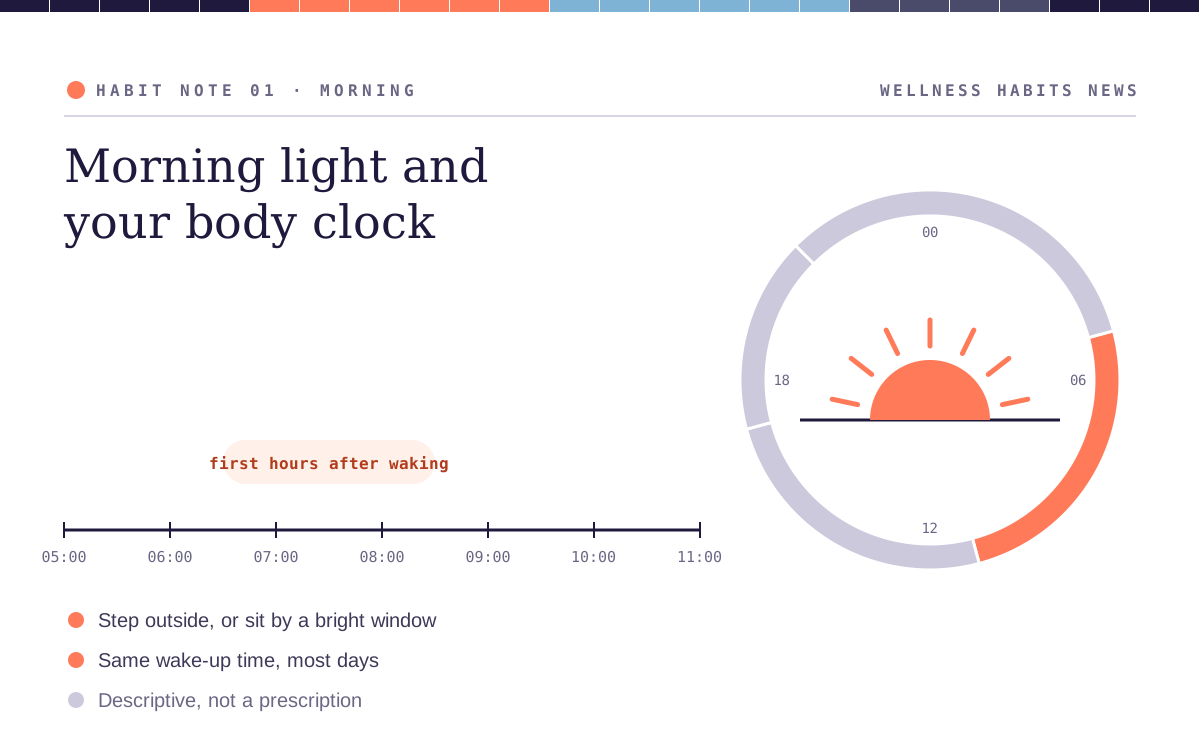
Why do so many sleep and health pages tell you to get outside in the morning? The short answer: light is the main signal the body uses to keep its internal clock lined up with the day, and research suggests that when you get light matters as much as how much. This note explains what that means in plain terms, what the evidence does and does not show, and a low-effort routine for the first hours of the day.
What researchers mean by the body clock
The National Institute of General Medical Sciences (part of the NIH) describes circadian rhythms as physical, mental and behavioral changes that follow a roughly 24-hour cycle. Nearly every tissue and organ in the human body has its own rhythm, and together they are tuned to the daily cycle of day and night [1]. Sleep patterns, body temperature and digestion are among the functions these rhythms influence.
Coordinating all of this is what NIGMS calls a master clock: a group of nerve cells in the brain known as the suprachiasmatic nucleus, or SCN. The SCN adjusts the production of melatonin, a signal the body makes more of in the evening, based on how much light reaches the eyes. In the evening, the master clock prompts the brain to make more melatonin, which is associated with sleepiness [1].
To stay in step with the outside day, the clock relies on cues from the environment. NIGMS notes that light and dark have the biggest influence on these rhythms, though food timing, physical activity, social routine and temperature play a part too [1]. Researchers use the German word zeitgeber ("time giver") for such a cue; a 2019 review in Somnologie calls ambient light the most important one reaching the SCN [2].
Light does not just wake you up in the moment. In the research, it also acts as a daily timing signal for the internal clock, and the direction of its effect depends on the time of day it arrives.
Why the timing of light matters in the research
The same 2019 review summarizes decades of laboratory work in one sentence that is worth knowing: roughly speaking, morning light moves the clock earlier, while evening and nighttime light push it later [2]. Scientists map this with what they call a phase response curve, which shows how a pulse of light shifts the clock depending on when it is given. The review also notes that the human circadian system appears to add up light across multiple exposures, even ones as short as five minutes [2].
The review also cites several studies in which daytime exposure to white light rich in shorter (bluish) wavelengths was associated with feeling more tired in the evening and with changes in measured sleep that night [2]. It is candid about limits, too: discussing the evening screen studies, the authors point out that the light exposure lasted four to six and a half hours and that it is unclear whether shorter exposures would give the same results [2]. In other words, the direction of the effect is fairly well described in labs; the size of the effect from an ordinary morning walk is much less certain.
One number from the review helps explain why "go outside" comes up so often: outdoor light can reach about 25,000 lux in full daylight and up to 100,000 lux in direct sun, while standard office lighting is only around 500 lux, often less [2]. Even a short time outdoors is a very different light signal from a morning spent under ceiling lights.
A small field study from 2013 gives a real-world picture. Eight adults spent a week living with ordinary electric lighting and then a week camping in the Colorado mountains in summer with only natural light. During the camping week, their daytime light exposure was more than four times higher on average, and measured markers of their internal clock, including the evening rise in melatonin, shifted about two hours earlier, lining up closely with sunset and sunrise [3]. It was a tiny group, in midsummer, living very differently from a normal workweek, so it shows what light can do to clock timing rather than what a typical person should expect.
Public guidance reflects the same idea without getting into the lab detail. The National Heart, Lung, and Blood Institute lists spending time outside every day, when possible, among its healthy sleep habits [4], the American Academy of Sleep Medicine suggests limiting bright light in the evening, and both the AASM and the CDC suggest turning off electronic devices at least 30 minutes before bed [5][6]. Morning light and dimmer evenings are two halves of the same pattern; our note on a simple wind-down hour covers the evening half.
A simple morning light routine, step by step
None of this requires special equipment. The sequence below is one way to fit daylight into an ordinary morning; the times are hints for someone who wakes around 06:30, so slide them to match your own day.
Open the curtains when you get up on waking
Let the room fill with whatever daylight there is before you reach for your phone. It costs nothing and turns the start of the day into a light cue rather than a screen cue.
Take a drink or breakfast near a window around 06:45
If you usually eat or have coffee in an inner room, move to the brightest spot you have, ideally beside a window that faces the open sky.
Step outside for a few minutes around 07:15
Walk to the mailbox, water a plant on the balcony, or take the long way to the car or bus stop. Gray days count too: you are still stepping out of indoor lighting and into daylight.
Build in a daylight commute or short walk before 09:00
If you can, walk or cycle part of the way to work, or take a short loop around the block before sitting down at a desk. Pairing it with an existing habit (dropping children at school, picking up coffee) makes it easier to repeat.
Keep the wake time roughly the same every day
A morning light habit works alongside a regular wake-up time; the AASM suggests getting up at the same time every day, weekends included [5]. Our note on a steady sleep schedule explains why.
Making it stick through the seasons
The routine is easy in June and harder in December, when many people wake and leave for work before sunrise. The research does not point to a single "correct" dose of morning light, so think of the steps above as a direction rather than a target. A few practical adjustments:
- On dark winter mornings, move your outdoor minutes to the first stretch of real daylight, such as a mid-morning break or an early lunch walk.
- Keep a coat, shoes and an umbrella by the door so a five-minute walk does not need planning.
- Use a desk or table by a window for the first task of the workday if you have the choice.
- Notice the pattern at the other end of the day too: bright screens and overhead lights late at night work in the opposite direction in the research.
- If you like a gentler start before sunrise, a lamp that brightens gradually before an alarm is one tool some people use as part of the routine (our Philips wake-up light entry describes one from its spec sheet). It is a wake-up routine tool, not a substitute for daylight, and we make no claim about its effect on the body clock.
Two cautions about what this habit is not. First, never look directly at the sun; "getting light" means being outdoors or near a window, not staring at a light source. Second, the lab findings on light and the internal clock describe groups of healthy volunteers under controlled conditions. They are useful for understanding why public guidance mentions daylight, but they do not tell you how much your own sleep or alertness will change.
If you have persistent trouble falling asleep, staying asleep or waking up, or you feel very sleepy during the day despite regular hours, talk to a clinician rather than relying on a light routine. The same applies if you have an eye condition or take medication that makes you sensitive to light. This habit note is general information for healthy adults.
Sources
- National Institute of General Medical Sciences (NIH). Circadian rhythms fact sheet. Content reviewed September 2023. nigms.nih.gov
- Blume C, Garbazza C, Spitschan M. Effects of light on human circadian rhythms, sleep and mood. Somnologie. 2019;23(3):147–156. PMID 31534436. PMC6751071
- Wright KP Jr, McHill AW, Birks BR, et al. Entrainment of the human circadian clock to the natural light-dark cycle. Current Biology. 2013;23(16):1554–1558. PMID 23910656. PMC4020279
- National Heart, Lung, and Blood Institute (NIH). Healthy sleep habits. Last updated March 24, 2022. nhlbi.nih.gov
- American Academy of Sleep Medicine. Healthy sleep habits (sleepeducation.org). Updated August 2020. sleepeducation.org
- Centers for Disease Control and Prevention. About sleep. Last reviewed May 15, 2024. cdc.gov
This habit note is general information and is not medical advice. Talk to a qualified clinician about your own sleep, activity, hydration or diet, especially if you have an existing condition or take medication.