What should the hour before bed look like? US sleep and health organizations give remarkably consistent advice: make it quiet, keep the light low, put screens away, and skip caffeine, heavy meals and alcohol late in the evening. None of it is complicated. The difficulty is doing it every night when there is a show to finish or email to answer. This note sets out what the guidance says, what the research on evening light found (and what it did not), and a simple sequence you can follow from about 20:30.
What the guidance says about the last hour
The National Heart, Lung, and Blood Institute suggests using the hour before bed for quiet time, avoiding intense exercise and bright artificial light, such as from a TV or computer screen, because the light may signal the brain that it is time to be awake [1]. The American Academy of Sleep Medicine's list of healthy sleep habits includes establishing a calm bedtime routine, limiting exposure to bright light in the evenings, and turning off electronic devices at least 30 minutes before bedtime [2]. The CDC's sleep page makes the same point about turning devices off at least 30 minutes before bed [3].
The same sources cover what goes in: the AASM suggests avoiding caffeine in the afternoon or evening, not eating a large meal before bedtime, avoiding alcohol before bed, and reducing fluids before bedtime [2]. NHLBI notes that the effects of caffeine can last up to 8 hours, so a late-afternoon coffee can make it harder to fall asleep at night; it also suggests keeping the room where you sleep quiet, cool and dark, and mentions a hot bath before bed as one option [1].
The public guidance is simple and consistent: lower light, screens off at least 30 minutes before bed, no late caffeine, heavy meals or alcohol, and a calm, repeatable routine in the last hour.
What the evening light and caffeine research found
The advice about screens rests partly on a well-known 2015 study in PNAS. Twelve healthy young adults lived in a lab for two weeks. For five evenings they read on a light-emitting tablet for about four hours before bed; for five other evenings they read a printed book, both in very dim room light [4].
After the tablet evenings, the rise in melatonin (a signal the body makes in the evening) was suppressed by about 55 percent on average, and its timing was more than 90 minutes later. Participants took nearly 10 minutes longer, on average, to fall asleep (about 26 versus 16 minutes), had somewhat less REM sleep, and felt sleepier the next morning [4]. These are meaningful findings, but the conditions were extreme compared with most evenings: four hours of reading with the screen at maximum brightness in a nearly dark room. A 2019 review of light research notes that exposure in studies like this was long (four to six and a half hours) and that it is unclear whether shorter exposures would give the same results [5]. The honest summary is that the direction of the effect is clear in the lab; how much a shorter, dimmer evening of screen use matters for a given person is not.
Caffeine timing has also been tested directly. In a small 2013 study, 12 healthy adults who normally slept well took a large dose of caffeine (400 mg, in pill form) at bedtime, 3 hours before bed or 6 hours before bed, and a placebo on another night, while sleeping at home [6]. Even at 6 hours before bed, an objective sleep monitor recorded more than an hour less sleep than on the placebo night. Participants' own sleep diaries showed a smaller reduction of 41 minutes at 6 hours, which fell just short of statistical significance (p = 0.08). The authors concluded that the results support the common advice to avoid substantial caffeine for at least 6 hours before bed [6]. It was one small study of a large dose, so it is a reason to be cautious about late coffee rather than a precise rule.
The wind-down hour, step by step
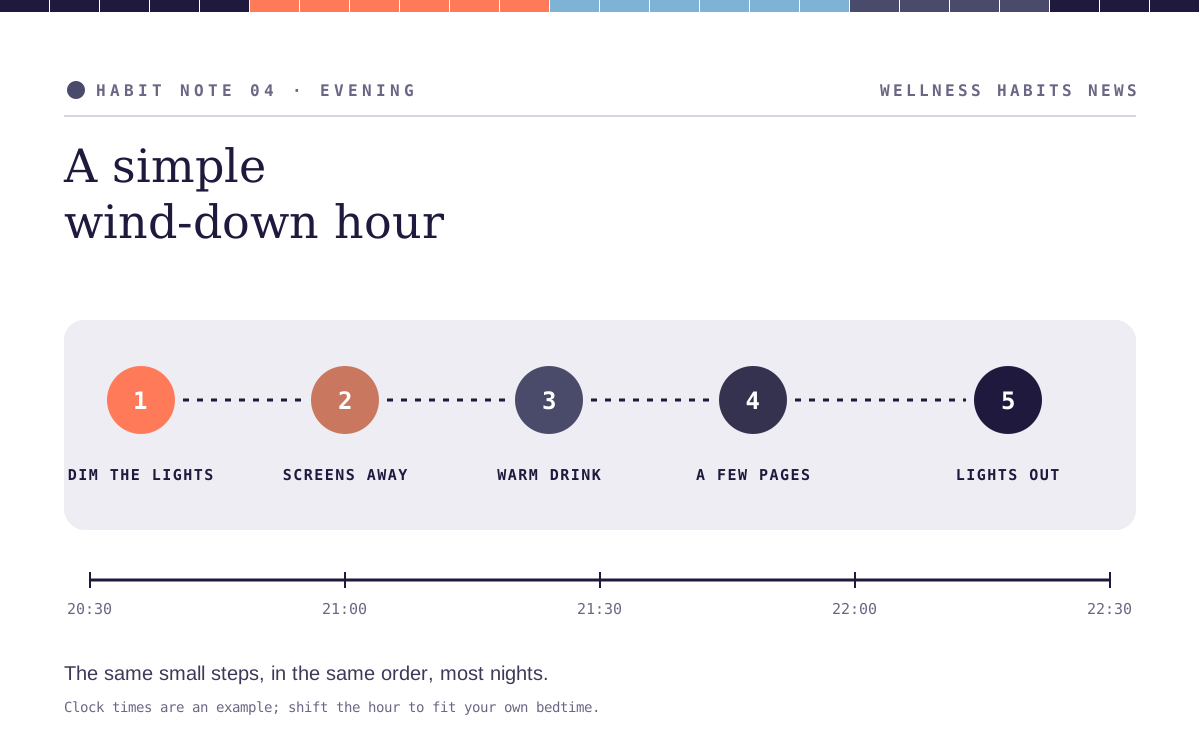
This sequence assumes lights out around 22:30. Slide it earlier or later to match your own bedtime; the order matters more than the clock. For many people the step that makes the rest possible is an afternoon cutoff for coffee, strong tea and cola, so the evening starts caffeine-free.
Dim the lights around 20:30
Switch off overhead lights and use one or two lamps instead. The AASM suggests limiting bright light in the evening [2]; you do not need special bulbs to act on that, just fewer and lower lights.
Put screens away around 21:00
Finish the episode, send the last message and plug the phone in to charge outside the room where you sleep, or at least out of arm's reach. The AASM and CDC suggest at least 30 minutes screen-free before bed; NHLBI suggests the whole hour be quiet time [1][2][3]. An alarm clock that is not your phone removes the main reason to keep it by the bed.
Make a warm caffeine-free drink around 21:15
A small mug of an herbal tea or warm milk can mark the change from day to night. Keep it small, since the AASM suggests reducing fluids before bed [2]. We make no claim that any particular herbal tea affects sleep: the NIH's National Center for Complementary and Integrative Health says there is very little information on chamomile's effect on sleep problems, and that people allergic to related plants such as ragweed, chrysanthemums, marigolds or daisies are more likely to react to it [7].
Read a few pages around 21:45
A paper book or magazine under a low lamp is a screen-free way to spend the last stretch. If a partner is already asleep, a small clip-on or neck-worn reading light keeps the rest of the room dark. A two-line journal entry about tomorrow can go here too.
Lights out at the same time around 22:30
Try to make lights-out roughly the same each night; that consistency is the subject of our note on a steady sleep schedule. The AASM also suggests not going to bed until you feel sleepy, and getting up for a quiet, low-light activity if you are still awake after about 20 minutes [2].
What to have on hand
Most of the routine needs nothing you do not already own. A short checklist for setting it up once:
- One or two lamps with warm, low light where you spend the evening, so dimming the room is a single switch.
- A charging spot for your phone outside the room where you sleep, and a basic alarm clock if you need one.
- A caffeine-free drink you enjoy, such as an herbal tea (our Twinings camomile entry reads one box's label and price).
- A paper book by the chair or bed, and a reading light that does not light up the whole room (our Vekkia reading light entry describes one from its spec).
- A room that is quiet, cool and dark by the time you get there, as NHLBI suggests [1].
- A reminder on your phone at 20:30 for the first week, until dimming the lights becomes automatic.
The morning half of the same pattern, daylight early in the day, is covered in our note on morning light and your body clock.
A wind-down routine is a habit, not a remedy. If you regularly have trouble falling or staying asleep, snore loudly, wake up gasping, or feel very sleepy during the day despite enough time in bed, talk to a clinician. The same goes if you take medication or have a condition that affects sleep. This habit note is general information for healthy adults.
Sources
- National Heart, Lung, and Blood Institute (NIH). Healthy sleep habits. Last updated March 24, 2022. nhlbi.nih.gov
- American Academy of Sleep Medicine. Healthy sleep habits (sleepeducation.org). Updated August 2020. sleepeducation.org
- Centers for Disease Control and Prevention. About sleep. Last reviewed May 15, 2024. cdc.gov
- Chang AM, Aeschbach D, Duffy JF, Czeisler CA. Evening use of light-emitting eReaders negatively affects sleep, circadian timing, and next-morning alertness. Proceedings of the National Academy of Sciences. 2015;112(4):1232–1237. PMID 25535358. PMC4313820
- Blume C, Garbazza C, Spitschan M. Effects of light on human circadian rhythms, sleep and mood. Somnologie. 2019;23(3):147–156. PMID 31534436. PMC6751071
- Drake C, Roehrs T, Shambroom J, Roth T. Caffeine effects on sleep taken 0, 3, or 6 hours before going to bed. Journal of Clinical Sleep Medicine. 2013;9(11):1195–1200. PMID 24235903. PMC3805807
- National Center for Complementary and Integrative Health (NIH). Chamomile. Last updated November 2024. nccih.nih.gov
This habit note is general information and is not medical advice. Talk to a qualified clinician about your own sleep, activity, hydration or diet, especially if you have an existing condition or take medication.