If most of your day happens in a chair, is it worth getting up for a few minutes at a time? Public guidance says yes in general terms: move more, sit less, and know that short bouts of activity count. What it does not say is exactly how often to stand up, because the evidence is not precise enough for that. This note walks through what the guidelines actually say, what one careful lab study of walking breaks found, and a simple schedule for a desk day.
What the activity guidelines say
The Physical Activity Guidelines for Americans, second edition, published by the US Department of Health and Human Services, recommend that adults get at least 150 to 300 minutes a week of moderate-intensity aerobic activity, such as brisk walking or fast dancing, plus muscle-strengthening activity on at least 2 days a week [1]. The first key guideline for adults, in HHS's own summary, is to move more and sit less [1].
Two changes in the second edition matter for a desk day. First, HHS states that any amount of physical activity has some health benefits. Second, the first edition said only bouts of 10 minutes or more counted toward the weekly total; the second edition removed that requirement to encourage people to move more often through the day [1]. The CDC's adult overview says the same in practical terms: the 150 minutes could be 30 minutes a day, 5 days a week, and you can break it up into smaller chunks of time [2].
The World Health Organization's 2020 guidelines, summarized in the British Journal of Sports Medicine, make a parallel recommendation: adults should limit the amount of time spent being sedentary, and replacing sedentary time with physical activity of any intensity, including light intensity, provides health benefits [3][4]. The WHO panel also said plainly that there was not enough evidence to set a specific numeric limit on sitting time [4].
Note what these guidelines are measured in: minutes of activity per week, not steps per day. A step counter can be a handy way to notice how much you move, but neither the US nor the WHO guidelines set a daily step target.
The guidelines count minutes, not steps, and short bouts count. There is no official rule for how often to get up from a desk; "move more, sit less" is the guidance, and breaks are one easy way to act on it.
What one lab study of walking breaks measured
Because the guidelines leave break frequency open, researchers have started testing specific break schedules. A 2023 randomized crossover trial published in Medicine & Science in Sports & Exercise is a useful example of what that research looks like [5].
Eleven middle-aged and older adults each completed five separate 8-hour sessions in the lab. In one session they sat for the whole time. In the other four they took light-intensity walking breaks on different schedules: 1 minute every 30 minutes, 5 minutes every 30 minutes, 1 minute every 60 minutes, and 5 minutes every 60 minutes. The researchers measured blood sugar every 15 minutes and blood pressure every hour [5].
Compared with sitting all day, only the most frequent and longest schedule, 5 minutes of walking every 30 minutes, produced a statistically significant reduction in the rise in blood sugar across the session. All four break schedules were associated with modest drops in systolic blood pressure compared with uninterrupted sitting, with the largest average reductions (roughly 4 to 5 mm Hg) for 1 minute every 60 minutes and 5 minutes every 30 minutes [5].
It is worth being clear about the limits. This was a small group, measured over single days in a lab, and it looked at short-term readings rather than long-term health. It suggests that how often and how long you break up sitting may make a measurable difference within a day; it does not tell you what a particular break schedule will do for you over months or years. The authors present their results as information about effective break doses, in an area where guidelines have not yet said how often or how long to break up sitting [5].
A plain break schedule for a desk day
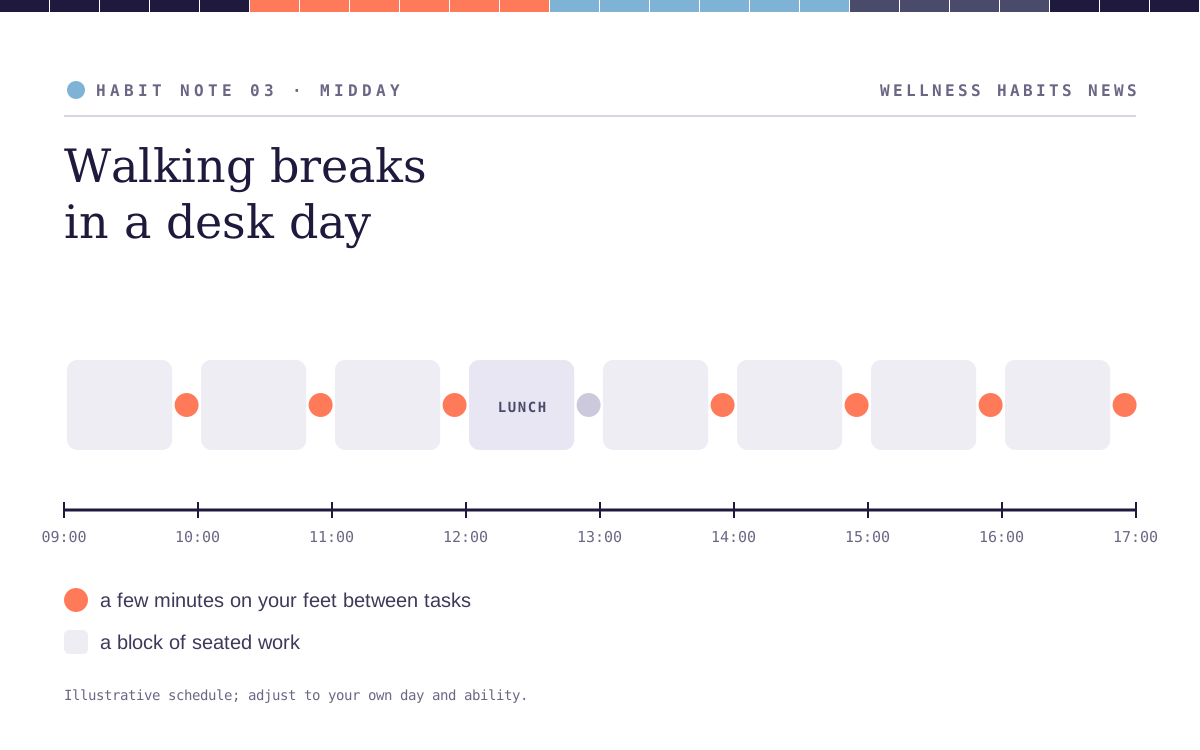
Here is one way to lay out a 09:00 to 17:00 desk day with short walking breaks, loosely based on the patterns tested in the research above. Adjust the timings to your meetings; the aim is regular, easy movement, not a precise protocol.
Start with a work block 09:00
Pick one task and work on it for 25 to 50 minutes. A visible timer can mark the block so you are not checking the clock (our Time Timer entry describes one).
Take a short walk around 09:45
Stand up and walk for a few minutes: to the kitchen, down a corridor, up and down a flight of stairs, or around the room during a phone call. Light, easy walking is enough; this is not a workout.
Repeat through the morning 09:00–12:30
Alternate work blocks and short walks. In the lab study, breaks every 30 minutes and every 60 minutes were both tested; choose the rhythm that fits your work, and if you can manage 5 minutes every half hour on some days, that was the most frequent schedule studied.
A longer walk at lunch around 12:30
Ten to fifteen minutes of brisk walking at lunch adds real minutes toward the weekly 150 in the guidelines, and gets you outdoors in daylight (see morning light and your body clock for why daylight comes up so often).
Keep the rhythm in the afternoon 13:30–17:00
Afternoons are when breaks tend to slip. Tie them to something that already happens: after each meeting, when you refill your water bottle (see drinking water through the day), or when the timer ends.
Making it stick
The hardest part of walking breaks is remembering them when you are absorbed in work. A few things make it easier:
- A cue you will notice: a visual timer, a calendar block, or the end of each meeting.
- A default route, so you do not have to decide where to go each time.
- Comfortable shoes at your desk if you usually wear formal ones.
- Walking phone calls: if a call does not need a screen, take it on your feet.
- Optional: a simple step counter to notice patterns across the week (our 3DFitBud entry describes one with no app or account). Remember the guidelines are in minutes, so think of the count as a rough record, not a target.
- A realistic bar for busy days: even one or two short walks is more movement than none, which is the spirit of "some physical activity is better than none" [2].
If you have a heart, lung or joint condition, are recovering from an injury or surgery, are pregnant, or have been told to limit activity, check with a clinician about what kind of movement is right for you. Stop and seek advice if walking brings on chest discomfort, unusual breathlessness, dizziness or pain. This habit note is general information for healthy adults.
Sources
- US Department of Health and Human Services, Office of Disease Prevention and Health Promotion. Top 10 things to know about the second edition of the Physical Activity Guidelines for Americans; and the current guidelines page. Top 10 things to know · Current guidelines
- Centers for Disease Control and Prevention. Adult activity: an overview. Last reviewed December 20, 2023. cdc.gov
- World Health Organization. WHO guidelines on physical activity and sedentary behaviour. Geneva: WHO, 2020. who.int
- Bull FC, Al-Ansari SS, Biddle S, et al. World Health Organization 2020 guidelines on physical activity and sedentary behaviour. British Journal of Sports Medicine. 2020;54(24):1451–1462. PMID 33239350. PMC7719906
- Duran AT, Friel CP, Serafini MA, et al. Dose-response analysis of a randomized crossover trial of walking breaks during prolonged sitting (title described in our words). Medicine & Science in Sports & Exercise. 2023;55(5):847–855. PMID 36728338. PubMed
This habit note is general information and is not medical advice. Talk to a qualified clinician about your own sleep, activity, hydration or diet, especially if you have an existing condition or take medication.