How much water should you drink in a day? The honest answer from the main US reference is that there is no single number of glasses everyone needs, and that most healthy people meet their needs by drinking when they are thirsty and having drinks with meals. That can feel unsatisfying, so this note explains where the familiar figures come from, what they include, and a low-effort way to keep water within reach through an ordinary day.
What the guidance actually says
The reference values used in the US and Canada come from a 2004 report by the Institute of Medicine of the National Academies, published in 2005 as the Dietary Reference Intakes for Water, Potassium, Sodium, Chloride, and Sulfate [1]. Because the data were not strong enough to set a precise average requirement, the panel set what is called an Adequate Intake instead, based on national intake data from people who appeared to be adequately hydrated [2][4].
The figures are often misquoted, so it helps to read the original wording. The National Academies' release said that women who appear to be adequately hydrated consume an average of about 2.7 liters (91 ounces) of total water a day, and men about 3.7 liters (125 ounces) [2]. "Total water" means everything: plain water, other drinks and the water in food. The same release said that about 80 percent of people's total water comes from water and other beverages, including caffeinated ones, and the other 20 percent from food [2].
Just as important is what the panel did not say. It explicitly declined to give a rule of thumb for how many glasses of water to drink, because hydration needs can be met through a variety of sources, and it stated that the vast majority of healthy people adequately meet their daily needs by letting thirst be their guide [2]. It added that people who are very physically active or live in hot climates may need more [2].
MedlinePlus, the NIH's consumer health site, gives the same range, between 91 and 125 fluid ounces (2.7 to 3.7 liters) a day for adults, and notes that individual needs vary with sex, body size, age, activity level and health. It says that if you drink fluids when you feel thirsty and have beverages with meals, you should get enough, and it points out that soup, milk, tea, coffee and juice all contribute, while alcohol does not add to the body's water [3]. The CDC similarly says daily water intake recommendations vary by age, sex, pregnancy and breastfeeding status and activity level, and that foods with high water content, such as many fruits and vegetables, add to fluid intake [5].
The often-quoted 2.7 and 3.7 liter figures describe total water from all drinks and food, not glasses of plain water. For most healthy people, the guidance is thirst plus drinks with meals, with more on hot or very active days.
What the research can and cannot tell you
A widely cited 2010 review in Nutrition Reviews looked across the evidence on water intake and health. It found that roughly a fifth of the water Americans take in comes from food, and it was frank about the gaps: there were few longer-term systematic intervention studies of water intake and no published long-term randomized controlled trials [4]. On mental performance, the review describes some studies in which mild dehydration disrupted mood and cognitive functioning and others in which it did not alter cognition in a consistent way [4].
The review also notes a point that surprises many people: although everyone feels thirsty from time to time, thirst plays little day-to-day role in controlling water intake in healthy people living in temperate climates. The authors observe that we mostly drink not to quench thirst but as part of everyday foods such as soup and milk, in drinks like tea and coffee, and for pleasure [4]. That is a useful way to see this habit. The goal is not to force down a quota but to make sure the ordinary routine of a day includes easy chances to drink, especially on the busy days when meals and breaks get skipped.
What this note will not do is promise a result. Drinking more water than you are thirsty for has not been shown in long-term trials to change health in healthy adults, and we do not claim that it makes you sharper, more alert or anything else. The habit here is modest: have water on hand and link drinking to moments that already happen.
A day of drinks, step by step
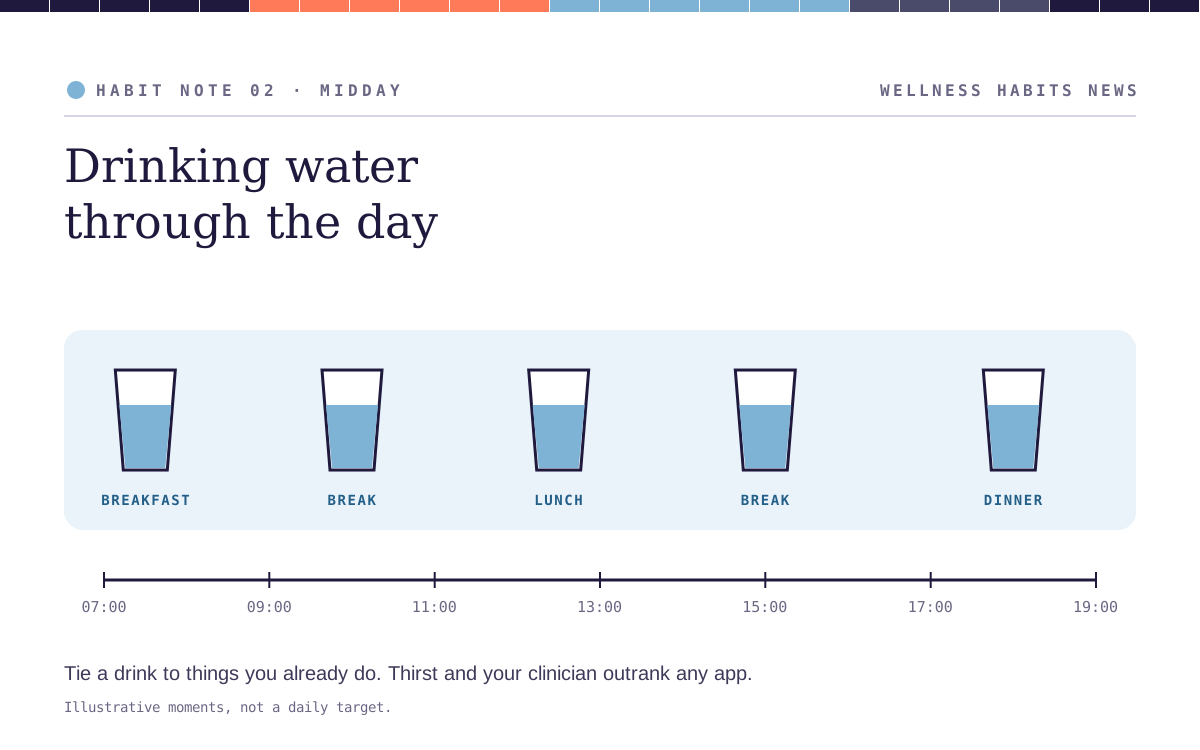
The easiest reminders are the ones attached to things you already do. Here is one way to spread drinks across a workday; the times are hints for a day that runs roughly 07:00 to 19:00.
A glass with breakfast around 07:00
Pour a glass of water alongside coffee or tea. Coffee and tea count toward total water too, according to the National Academies [2]; the water glass simply gives you an easy start.
Fill a bottle before you sit down around 08:30
The CDC's first tip is to carry a reusable water bottle [5]. Fill it when you start work and put it where you can see it, next to the keyboard rather than in a bag.
Refill at the mid-morning break around 10:30
Tie the refill to getting up from your desk. If you already take a short walking break (see our note on walking breaks in a desk day), route it past the kitchen or water fountain.
Water with lunch around 12:30
Serving water with meals is another CDC suggestion [5], and it is what MedlinePlus has in mind with "beverages with meals" [3]. Choosing water over sugary drinks is also on the CDC list.
Afternoon refill around 15:00
Refill the bottle at your afternoon break, the same way you did mid-morning. On hot days, after exercise or after a long walk, drink more.
Drinks with dinner, then taper from 19:00
Have water or another drink with dinner, then ease off later in the evening. The American Academy of Sleep Medicine lists reducing fluid intake before bedtime among its healthy sleep habits [6], so front-loading the day makes sense.
Making it easy
A few low-effort changes do most of the work. None of them requires an app or a target:
- A bottle you actually like carrying, sized so it needs one or two refills a day rather than five. Our Owala FreeSip entry describes one 24-ounce option from its spec and care guidance.
- A visible spot on the desk, not a drawer or bag.
- Refills tied to existing moments: arriving, breaks, meals, leaving.
- A wedge of lemon or lime, or a bottle frozen the night before for ice-cold water through the day, if plain water feels boring (both are on the CDC's list of tips) [5].
- Extra water planned for hot days, travel and exercise, when the National Academies say needs may be higher [2].
- An easing-off point in the evening so drinks are mostly done a couple of hours before bed.
If you use a timer to mark work blocks and breaks, it can double as a refill reminder; our Time Timer entry covers one visual timer. The tool is only a cue; thirst and mealtimes remain the guide the public sources describe.
Some people are advised by their clinician to limit or increase fluids because of a heart or kidney condition, a medication or a medical procedure; follow that advice over any general guidance. Also talk to a clinician if you are unusually thirsty all the time, need to urinate much more than usual, or feel dizzy or unwell in the heat. This habit note is general information for healthy adults.
Sources
- Institute of Medicine. Dietary Reference Intakes for Water, Potassium, Sodium, Chloride, and Sulfate. The National Academies Press, 2005. nationalacademies.org
- The National Academies. News release on the report setting dietary intake levels for water, salt and potassium. February 11, 2004. nationalacademies.org
- MedlinePlus Medical Encyclopedia (National Library of Medicine). Water in diet. Reviewed July 9, 2025. medlineplus.gov
- Popkin BM, D'Anci KE, Rosenberg IH. Water, hydration, and health. Nutrition Reviews. 2010;68(8):439–458. PMID 20646222. PMC2908954
- Centers for Disease Control and Prevention. About water and healthier drinks. Last reviewed March 5, 2026. cdc.gov
- American Academy of Sleep Medicine. Healthy sleep habits (sleepeducation.org). Updated August 2020. sleepeducation.org
This habit note is general information and is not medical advice. Talk to a qualified clinician about your own sleep, activity, hydration or diet, especially if you have an existing condition or take medication.